The Quiet One

Laos

The country its neighbours have not caught up with. Monks at dawn, a waterfall the colour of glass, and a slow brown river that still does most of the travelling.

Laos is what Thailand was thirty years ago, said so often that it has become a cliché, and it is still roughly true. There is one town everybody comes for, one landscape everybody photographs, and a capital that feels like a large market town with a golden stupa in it.

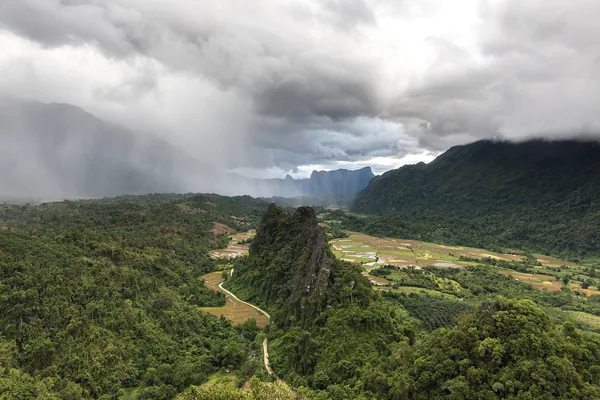
Two nights does Luang Prabang. Five nights takes the new railway south through the karsts to Vientiane, which is the version worth doing if you have the days.

Airports
Luang Prabang, Vientiane
Both take international flights, neither takes one from India. You will connect, most often through Bangkok.
Best months
November to February
October is the quiet secret. March and April bring haze from the burning and the year's worst air.
Getting there
One stop, usually Bangkok
Around 4h to Bangkok, then 2h on to Luang Prabang. Allow a long layover or an overnight.
Nights to allow
2 to 5
Two is enough for Luang Prabang alone. Five gets you the train south through Vang Vieng to Vientiane.
Visa
On arrival
Indian passports get a visa on arrival at both international airports. Carry photographs and US dollars in cash for the fee.
Money
Lao kip
Dollars and baht are taken almost everywhere. Cards are accepted in hotels and very little else — carry cash.

Decide first

Which part of Laos, and who each one suits

The reason most people come Its own airport

Choose it if

  • You want the single most attractive town in Southeast Asia. UNESCO listed the whole of it, not a building in it, and that is the right call.
  • Temples, a French colonial main street and a night market you can walk end to end in twenty minutes.
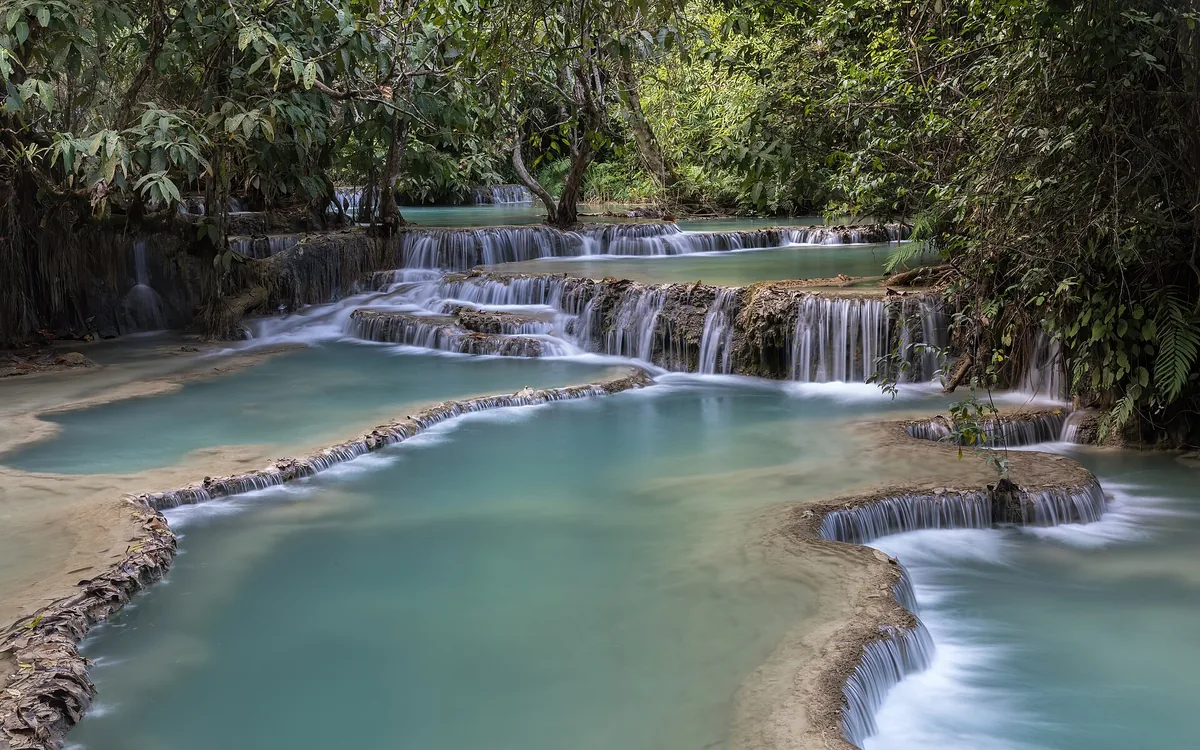
  • Kuang Si — the waterfall everybody photographs — is an hour out and genuinely as good as the pictures.
  • You have two or three nights and want them all in one place.

Think twice if

  • You want nightlife. The town has a curfew and keeps it.
  • You want beaches. Laos is landlocked; this is the one country in the region with no coast at all.

Decide second

When to travel, month by month

taller bar means more rain

Pick a month to read it in full.

Cool and dry

January

Rain
Dry
How busy
Busy
Daytime
15 to 28°C

The best month. Dry, clear, and cool enough in Luang Prabang at dawn to want a jacket for the alms round. It is also the busiest and the most expensive, and the good small hotels go early.

Background

A little history

Laos was Lan Xang — the kingdom of a million elephants — from the fourteenth century, and for three hundred years it was the largest state in Southeast Asia. It broke into three in 1707, fell to the Siamese, and was taken by France in 1893 as the last and least-considered piece of French Indochina.

The twentieth century was hard in a way the country still does not advertise. Between 1964 and 1973 the United States dropped more than two million tonnes of ordnance on Laos, most of it on the Ho Chi Minh trail in the east — more bombs than fell on Germany and Japan together in the Second World War, on a country that was never formally at war. Around a third failed to detonate, and clearing it is still ongoing work.

The monarchy ended in 1975 and the Lao People’s Democratic Republic has governed since. What a visitor meets is a country that is quiet, courteous and unhurried, and which has decided not to chase the tourism its neighbours built. The railway to China opened in 2021 and is changing that faster than anything in fifty years.

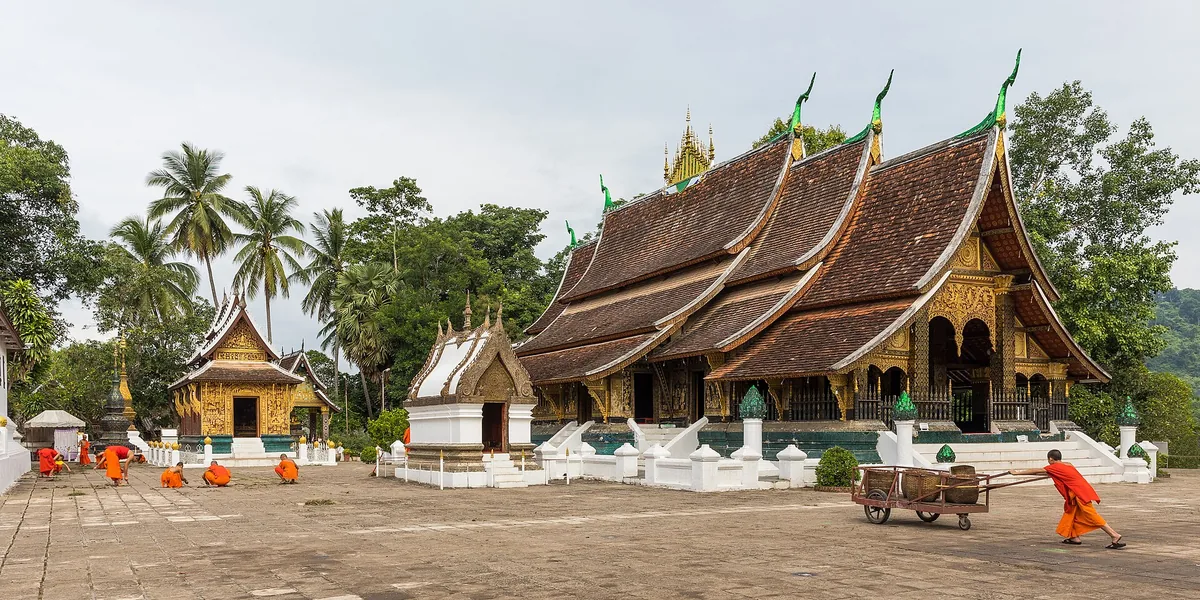
The sweeping roofs of Wat Xieng Thong in Luang Prabang, monks crossing the yard.
Photo: Basile Morin · CC BY-SA 4.0
The turquoise tiered pools of the Kuang Si waterfall near Luang Prabang.
Photo: Basile Morin · CC BY-SA 4.0

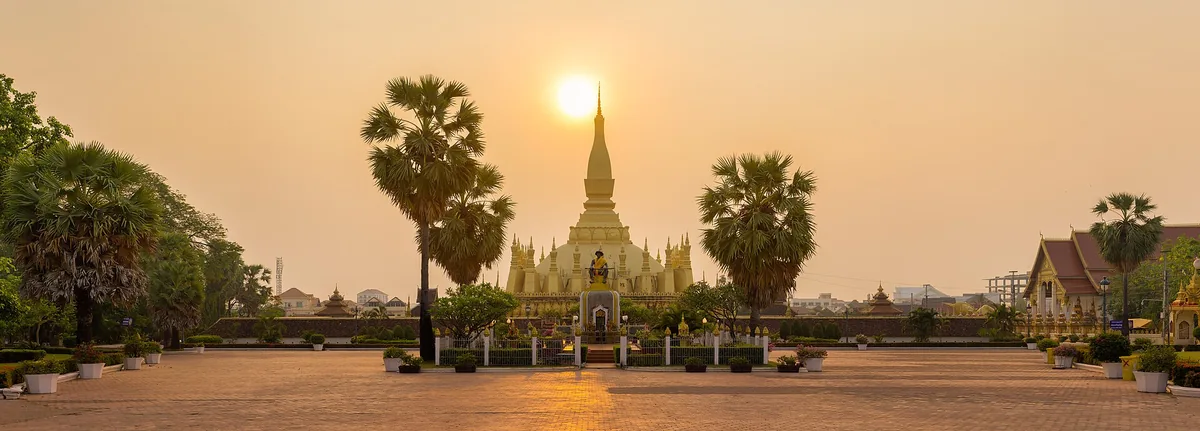
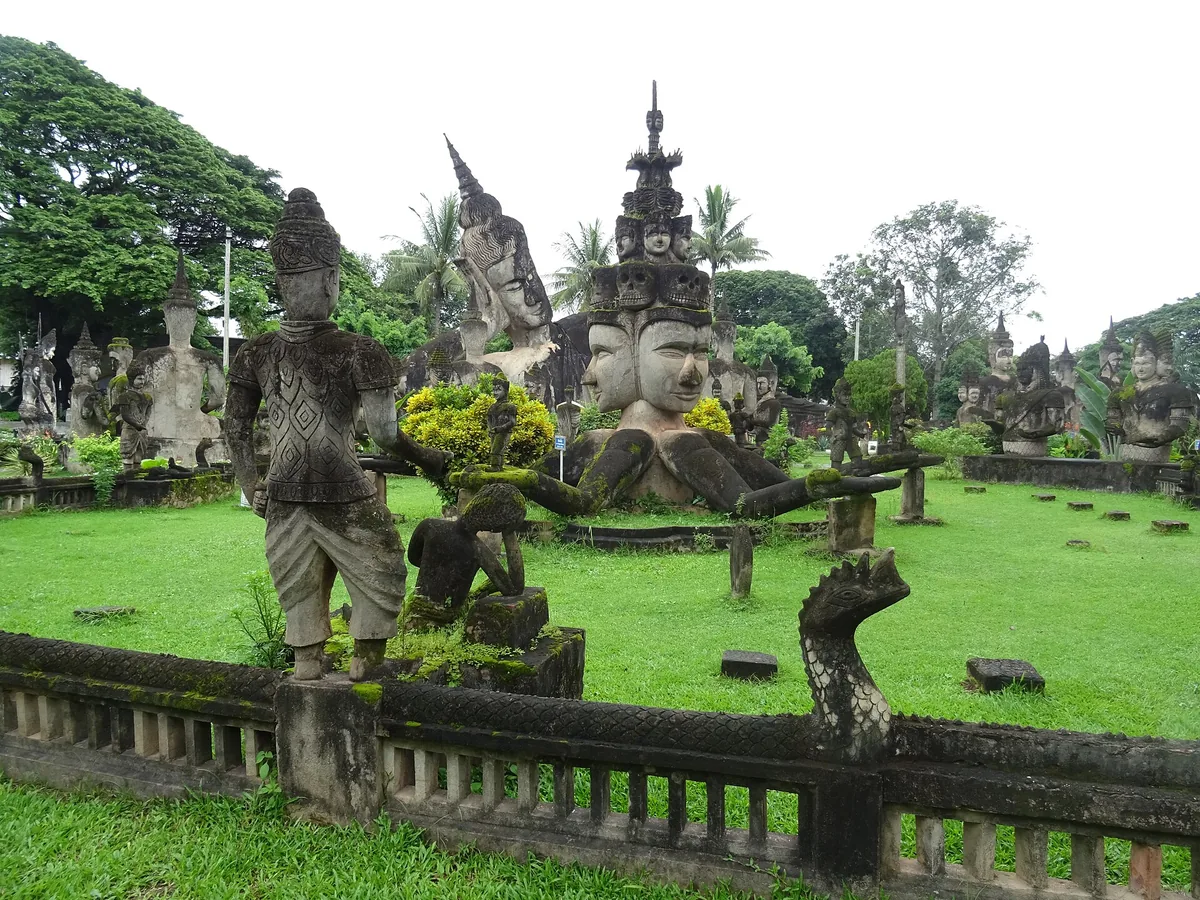
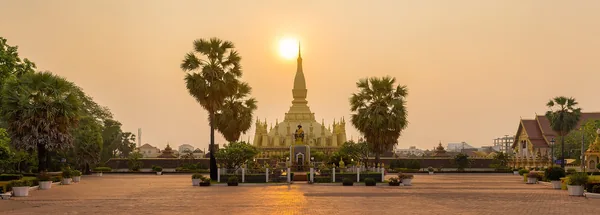
The arch in Vientiane was built with cement the Americans had given the country to lay a runway.

Practical

Know before you go

Visas and entry

Indian passport holders get a visa on arrival at Luang Prabang and Vientiane international airports, and at the main land borders with Thailand. It runs 30 days.

Bring two passport photographs and the fee in US dollars, in cash — the desk does not take cards and the rate it gives for other currencies is poor. Your passport needs six months of validity.

We confirm the current fee in writing when we quote, because it has moved and because it differs by nationality at the same desk.

Money

The Lao kip, and it has a lot of zeros — a 100,000 kip note is roughly ₹390. Prices in tourist places are quoted in dollars or baht as often as kip, and all three are accepted in practice.

Carry cash. Cards work at hotels and at almost nothing else; ATMs exist in both cities and have low withdrawal limits. There is no UPI here. Get kip for markets, tuk-tuks and small restaurants, and keep dollars for the visa and for anything priced in them.

The country in brief

Size
236,800 km², a little larger than Uttar Pradesh
People
About 7.7 million
Coast
None — the only landlocked country in Southeast Asia
Neighbours
Five: China, Vietnam, Cambodia, Thailand and Myanmar
Highest point
Phou Bia, 2,819 m
Clock
UTC+7 — an hour and a half ahead of IST
Traffic
Drives on the right

Two worth carrying. The Mekong runs through the country for nearly 1,900 kilometres, more of it than through any other, and it is still the road for a good deal of the north. And Laos is the most bombed country per head in history — a fact the guides will tell you plainly if you ask, and never volunteer.

Plugs and power

230 volts at 50 hertz, and the sockets take a mixture of flat American pins and round European ones. Most Indian round-pin plugs go straight in. Take one universal adapter and you are covered for the rest.

Power cuts are not unusual outside the two cities. Hotels of the standard we book run generators; charge things when you can regardless.

230 volts, 50 hertz — the same as home.

Language

Lao, which is close enough to Thai that the two are mutually intelligible at a basic level. The script is different but related.

English is spoken by guides, at hotel desks and in restaurants that see visitors, and thins out quickly beyond that. Every package we sell here includes an English-speaking guide for exactly that reason. French survives among older people, a leftover of the colonial century.

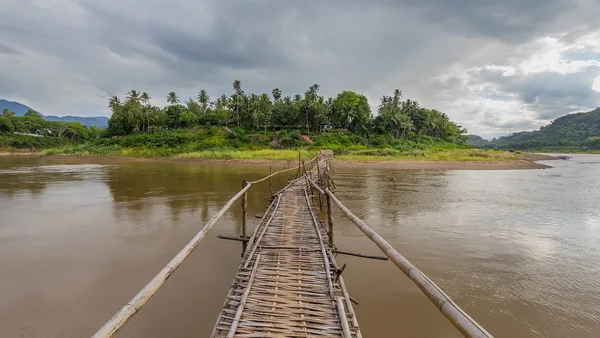
A bamboo footbridge across the Mekong to Luang Prabang, hills behind.

Food

Sticky rice, eaten with the fingers, is the national staple and the thing Lao people will tell you first. Laap — minced meat or fish with herbs, lime, chilli and toasted rice powder — is the national dish and is very good. Tam mak hoong is the green papaya salad Thailand exported as som tam; the Lao original is fiercer.

Luang Prabang has its own dishes worth ordering: or lam, a herby stew with a bitter wood that numbs slightly, and the Mekong riverweed served crisp with sesame. The baguettes are a French leftover and are genuinely good.

Vegetarians manage, with warning. Fish sauce and pork fat are close to universal, so tell us in advance and we brief the guide and the hotels rather than leaving you to negotiate it three times a day.

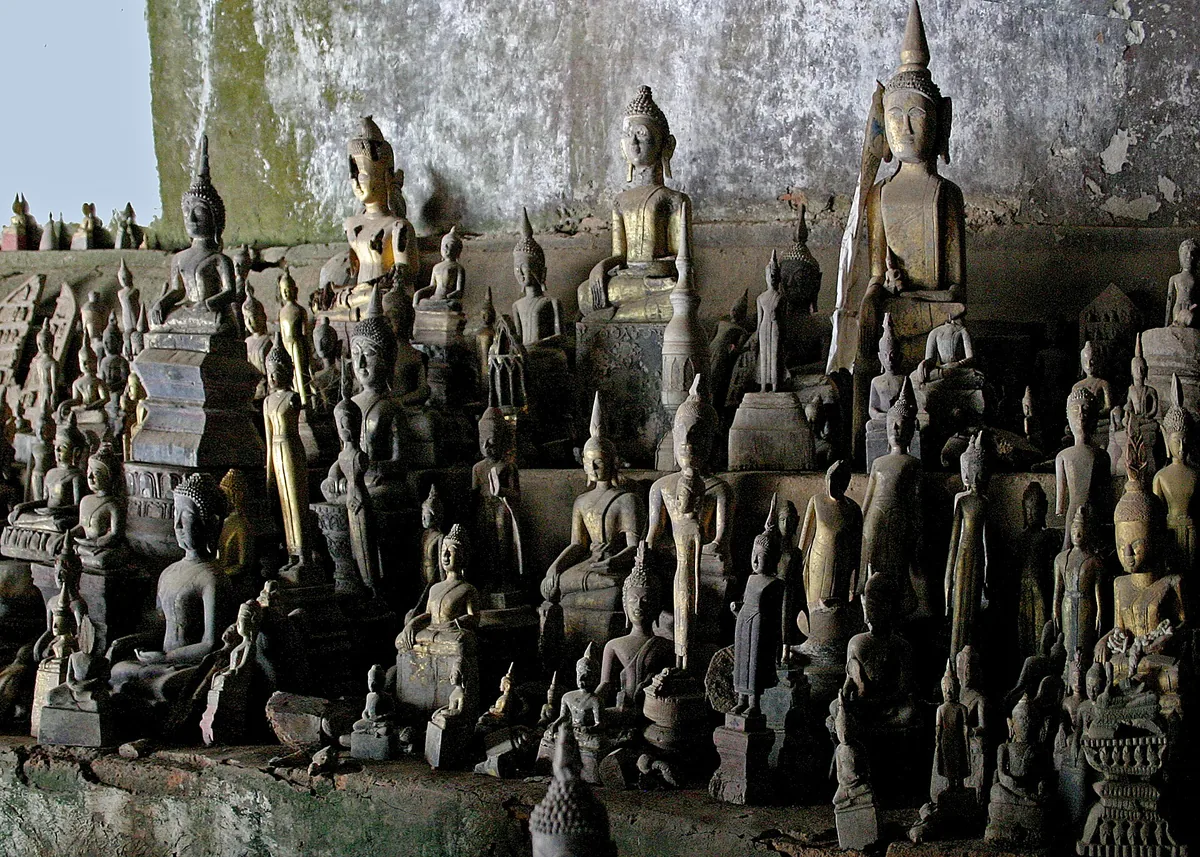
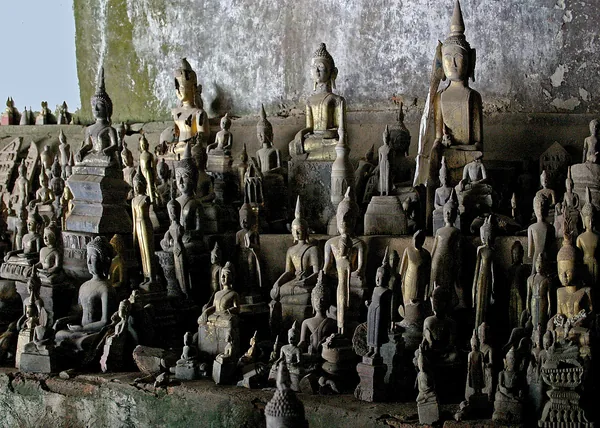
Hundreds of Buddha figures left in the Pak Ou caves above the Mekong.

People and culture

Theravada Buddhism, practised seriously. Most men ordain as monks for at least a short period, and the orange robes you see everywhere belong to people who live in the temples you are visiting.

The dawn alms round in Luang Prabang — Tak Bat — is a religious observance and not a performance. If you watch, watch from a distance, stay seated or kneeling so your head is below the monks’, do not use a flash, and do not photograph faces close up. If you want to give alms, arrange it through the guide beforehand rather than buying rice from a hawker on the street.

At temples: shoulders and knees covered, shoes off, and do not touch a monk if you are a woman. Feet are impolite pointed at people or images.

How the country is run

A one-party socialist republic, governed by the Lao People’s Revolutionary Party since 1975. In practice a visitor notices this only in the paperwork and in a general reticence about politics.

The useful practical consequence: do not photograph military installations or personnel, and do not expect a conversation about the government to go anywhere. Neither is a hardship on a five-night holiday.

Worth knowing before you go

The one thing worth taking seriously is unexploded ordnance. It is not a risk on any itinerary we sell — the sites, the towns and the roads are long cleared — but the rule everywhere in Laos is to stay on marked paths in rural areas and never to touch metal debris. In the east, where the trail ran, this is a live danger rather than a historical note.

Beyond that it is a gentle country. Drink bottled water, use repellent because dengue is present, and treat the river with respect: the Mekong runs faster than it looks and drownings are the most common serious accident that happens to visitors here.

Drug offences carry severe penalties, including for things sold openly in a few places in Vang Vieng. The openness is not permission.

Not sure where to start?

Talk to someone who has been. We will tell you honestly whether Laos suits the trip you have in mind.

Photography